More STAR TREK! And a song that, once heard, will stay in your head for days (sorry about that!): the summer 1987 British hit single (and Trek cliche compilation) STAR TREKKIN' by The Firm.
British TV-and-pop weekly LOOK-IN jumped on the bandwagon with this cover and song words pull-out which'll help you sing along.
Just close your eyes... and pretend you're back at that convention disco...
I watched the pilot episode of CW's new revival of BEAUTY AND THE BEAST the other night. Whilst its not a bad show in its own right (I'd need to watch a few more episodes before I made a definitive judgement on that score), I was struck by how much LESS risk-taking it was compared with the 1987 original.
The new Catherine Chandler has none of the dignity and grace of Linda Hamilton but - more importantly - her Vincent is just a good-looking bloke with a bit of a facial scar. Maybe a man dressed as a lion is a little cheesy for the CW's teen audience but - really - they could have done a bit better than that. And the unfortunate subtext is: minor facial deformity = beast!
This is a nicely assembled compilation of original series clips put to the show's memorable title music.
And, of course, Disney also already owns THE MUPPETS, another great opportunity for synergy across the expanding Disney Empire. Somehow.
Here's when THE MUPPET SHOW collided with the STAR WARS universe in 1980.
The episode was shot at ATV's Elstree Studios (now BBC Elstree, home of EastEnders), just a short distance away from the Elstree Film Studios base of THE EMPIRE STRIKES BACK, which was shooting on its stages at the time.
Frank Oz, of course, is another connection between the two worlds. Enjoy!
Here's a rarity from 1978: a British TV spot promoting the comics'n'features weekly LOOK-IN, an essential read for a generation.
This particular spot mentions both MAN FROM ATLANTIS and Universal's Bionic shows.
If you're wondering how a comic could afford a national TV advert (when Marvel plugged the likes of G.I. JOE or THE TRANSFORMERS in the states they were using Hasbro marketing money to circumvent strict rules on TV toy advertising) for anything other than the launch issue, the answer is simple!
LOOK-IN was published by ITV PUBLICATIONS which - as the name suggests - was a spin-off from the ITV network. Created primarily to publish the ITV listings magazine TV TIMES, ITVP (which was owned by the fifteen regional companies that made up the ITV network) created LOOK-IN as a TV Times spin-off (officially: the junior TV Times). ITVP were free to advertise their wares every week on the ITV network. The BBC did exactly the same with their listings magazine RADIO TIMES and other commercial ventures. Changes in legislation, and ownership, now prevent such obvious cross-promotional synergy.
Here it is: the seldom-seen (and not on DVD goshdarnit) full-length Filmation animated movie FLASH GORDON: THE GREATEST ADVENTURE OF THEM ALL, in nine easy chunks courtesy of a random stranger on You Tube.
Originally produced in the late seventies, the movie was shelved until 1982.
Here's an interesting oddity I picked-up a few years ago online: two pages (four printed sides) from the 1989 ITV STYLE GUIDE relating to ANGLIA TV.
Although often referred to as ITV, and occasionally used on-screen as an overarching description of the 15 regional companies (plus TVam the breakfast contractor and ITN, the news service*) that made up the network, 1989 was the first time that ITV had tried to roll-out a consistent national brand across all regions. Needless to say, it didn't quite go as planned.
The idea was simple enough: every region would use the ITV logo on-screen but each version would be slightly different, using the "V" to incorporate elements of their existing branding. A clever, in the circumstances, solution.
However, at this point in the broadcaster's history it was still (unlike today) a loose affiliation of independently owned and managed regional operations, each of which holding (but not owning) the license to broadcast in their own geographical area. As a result, not every region adopted the new "house style".
These pages are extracted from what was, presumably, a much thicker guide which included all regional variations as well as the overall ITV national brand. It's interesting (to me at least) for two reasons:
1. Anglia Television, covering the East Anglian region, was 'my' ITV broadcaster growing up.
2. Anglia never adopted the on-screen look shown here.
Anglia launched, in October 1959, with the classic knight-on-a-horse statue on-screen identity. Amazingly, the knight survived, virtually unchanged, well into the 1980s. This left Anglia looking increasingly anachronistic compared with its slicker neighbours to the north(ish) (Central) and south (LWT).
In 1988, the company drafted in designers Lambie-Nairn to overhaul the station's entire on-screen look. The tradition of the knight was retained in the new design: a heraldic pendent (known to viewers as the "Anglia flag") which fluttered on-screen in all its CG glory. Continuity announcers, previously normally seen in-vision, were relegated to voice-only work (except during the long gaps between programmes in the overnight schedules).
With such a radical overhaul only a year old, it was probably no surprise that Anglia's powers-that-be rejected the opportunity to jump aboard the national brand.
Copies of the full style guide (or "manual" as it describes itself) were presumably dolled out, along with the requisite video elements on tape to the presentation departments of each company. The guide was intended to show/ remind each company how the logo was to be used on-air, preventing inconsistencies and brand no-no's when unleashed onto 15 different Graphics teams.
Here, courtesy of You Tube, is a nice compilation of Anglia's on-screen identities.
Below is a compilation of ITV 1989 regional identities from the companies that used it (IE most of them!):
THE ANGLIA STYLE GUIDE
* Both of which sat outside the main ITV structure: ITN was jointly owned by the regional ITV companies to provide them all with national and international news bulletins. TV-am held the national breakfast franchise (operating across the ITV network from 6-9.25am seven days a week) and sold its own airtime, an arrangement that put it in direct competition with the regional broadcaster's airtime sales teams (who also, at this point, also sold Channel Four's advertising space).
The actor Richard Lynch died this week at the ripe old age of 76. His scarred face (the result of an accident while freebasing) and menacing acting style will make him instantly familiar to a whole generation of avid viewers of US action/ adventure shows (as well as a host of movies). He really was the go-to guy for menace.
To give you an idea how busy this guy was (and to help you organise your own DVD tribute to the great man), here's a partial list of his TV series work from the late seventies and into the eighties: BATTLESTAR GALACTICA (Gun on Ice Planet Zero), BUCK ROGERS IN THE 25TH CENTURY (Vegas in Space), CHARLIE'S ANGELS (Angels on the Street), GALACTICA 1980* (Galactica Discovers Earth), THE PHOENIX (series regular), BRING 'EM BACK ALIVE (Escape From Kampoon), T.J. HOOKER (Carnal Express), MANIMAL (Illusion), MASQUERADE (Flashpoint), BLUE THUNDER (Second Thunder), AUTOMAN (Renegade Run), MATT HOUSTON (Apostle of Death), COVER UP (Murder in Malibu), THE A-TEAM (Hot Styles), THE FALL GUY (The Winner, Pleasure Isle, Stranger Than Fiction), RIPTIDE (Curse of the Mary Aberdeen), SCARECROW AND MRS KING (You Only Die Twice), AIRWOLF (The Horn of Plenty), THE LAST PRECINCT (Never Cross a Vampire), ONCE A HERO (The Return of Lazarus), WEREWOLF (Nightmare at the Braine Hotel), HUNTER (Legion), STAR TREK: THE NEXT GENERATION (Gambit) and many more!
He was also the villain in the Slow-Robot favourite TRANCERS II (1991).
*Lynch's role as renegade Colonial Xavier was meant to be the show's recurring villain. Lynch signed the contract but ABC rushed the (short-lived) weekly series into production so quickly that Lynch was oversees filming throughout. When Xavier did eventually return, he was played (improbably) by Jeremy Brett. The episode, Spaceball, was a stinker (in a show full of stinkers), so Lynch had a lucky escape.
A quick rummage around You Tube for a suitable tribute uncovered VAMPIRE, a 1979 piece of classic Lynch. Enjoy!
Here's a turtle-necked US TV treat from the late seventies flogging the futuristic wares of Mego's MICRONAUTS toy line. The Madison Avenue types were clearly more interested in convincing moms and dads of the SF toys quasi-educational benefits than convincing the kids that these were unmissable magnetised plastic playthings.
The MICRONAUTS toys also spawned a Marvel comic book (which greatly expanded on the almost non-existent back-story concocted by Mego for their Japanese-import toys), a mainstay of late seventies/ early eighties Marvel comics on both sides of the Atlantic.
This is a (almost) 100 second promo video, from the late seventies, plugging the wares of the notoriously rigid ROM electronic toy, an over-priced item that Parker thought would give them an entree into the boys action figure market.
The video is too long to be a traditional TV spot (unless Parker Brothers were unafraid to splash some serious stash) so it was more likely concocted for Toy Fairs, b2b marketing events, presentations to retailers or in-store looped video promotions (of the JML variety).
The toaster-headed toy didn't gain traction and faded fast although the Marvel comic tie-in (published in the UK in FORCES IN COMBAT, FUTURE TENSE and STAR WARS) was a winner.
In the UK, the Rom toy was licensed to Palitoy and incorporated into their ACTION MAN line.
THE CHILDREN'S FILM FOUNDATION: purveyors of risk-free adventure, flairs and dodgy actors and providers of convenient BBC schedule-fillers.
This 1977 (STAR WARS didn't reach the UK until late December 1977), although its likely that the CFF knew Lucas' UK-lensed epic was on its way, and doing good business stateside) SF "blockbuster" was directed by Harley Cokeliss (also responsible for the CFF classic THE BATTLE OF BILLY'S POND as well as, apparently, THE MAKING OF THE MUPPET SHOW and episodes of adventure shows like HERCULES, XENA, ROBIN HOOD and CI5: THE NEW PROFESSIONALS).
Here, in it's glorious entirety, is THE GLITTERBALL (1977), a pre-E.T. no-budget UK alien visitor romp, without the BMX bikes.
There was also a book version, above, by writer Howard Thompson, published by Magnet in 1979. Slow Robot remembers being forced to read it as part of a summer holiday library reading scheme. Slow Robot never finished it.
The BBC, presumably short of dosh, cheekily reran creaky old CFF flicks in an afternoon slot from 1985-89. A quick way of filling a whole afternoon. Slow Robot can't recall if The Glitterball aired in this slot.
The CFF was established in 1951 and ceased production in the eighties. Amongst the last to be shot was DOOMBEACH (1989), with Glen Jackson, produced by the Children's Film Unit (successor to the Foundation), shot in Dorset and aired on Channel Four.
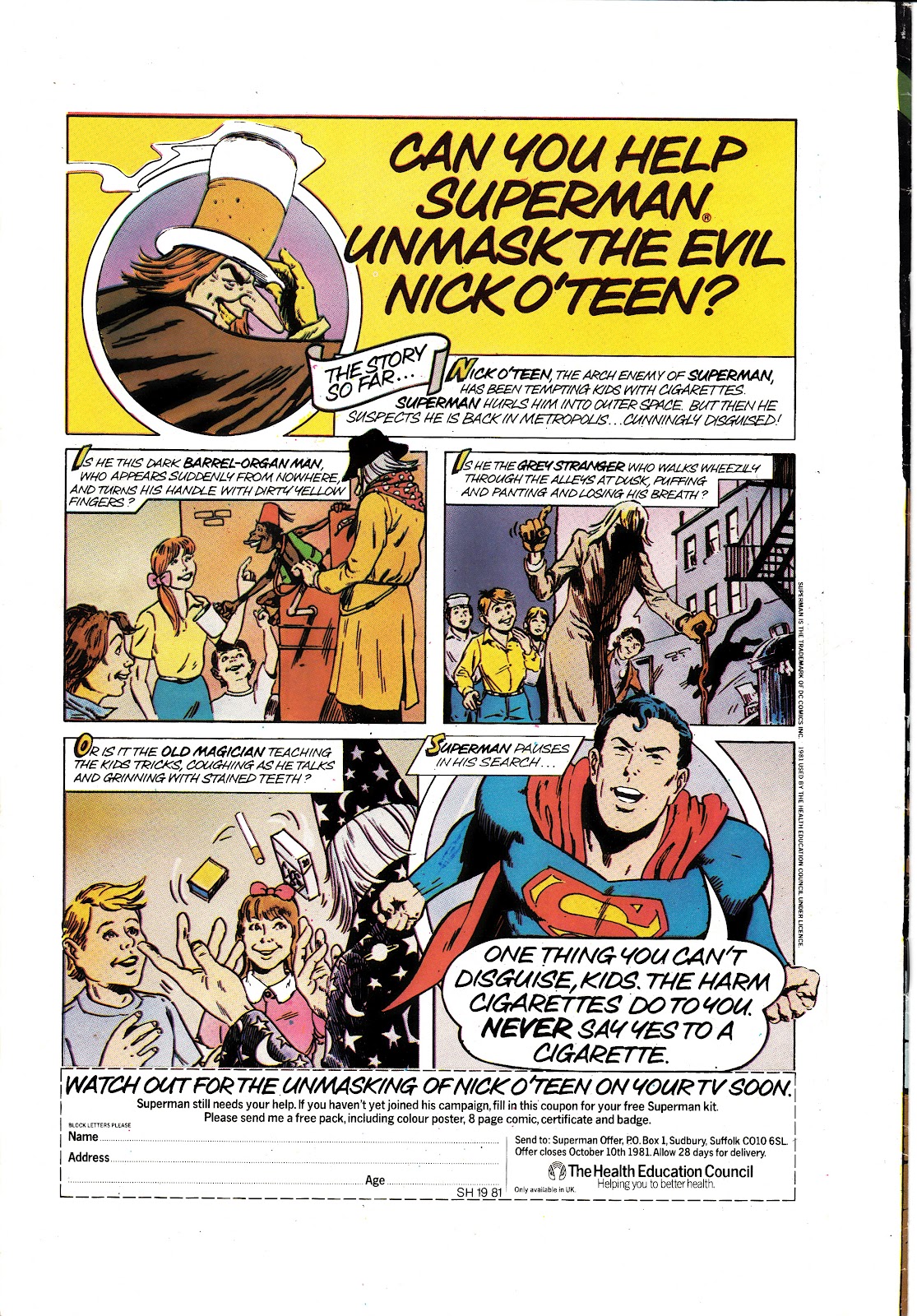
The early 1980s saw the Man of Steel facing-off against Nick O'Teen, devious corrupter of pre-pubescent lungs, in a series of TV and print adverts (appearing in IPC and Marvel UK, and probably elsewhere, titles) bankrolled by the UK's Health Education Council.
Three TV nicely produced animated Public Service Announcements also ran as part of the campaign.
Remember kids: Never Say Yes to a Dirty Old Man who smells nasty!
During the 1980s, US covert anti-terror force G.I. JOE operated in the UK as ACTION FORCE!
When Hasbro took over the line from the winding-down Palitoy (who launched Action Force in the UK in 1982 as a miniaturised version of their declining perennial ACTION MAN) in 1987, they aligned it as closely as possible with their US G.I. Joe line (Palitoy had been issuing the toys, under license and under the Action Force banner since 1985). The changes included streamlining the range (some toys were dropped, others added), new packaging, puncher print and TV advertising, a new licensing deal with Marvel UK (replacing the Action Force strips that IPC had published in BATTLE ACTION FORCE since 1983) and the release of the G.I. Joe animated series (produced by Sunbow and Marvel Productions) in the UK for the first time.
Hasbro presumably retained the Action Force brand because it was a known quantity to retailers and consumers and, possibly, because the name G.I. Joe was meaningless to Brits. Certainly the "Real American Hero" subtitle couldn't cross the Atlantic and Action Force became "International Heroes".
Hasbro never found a UK broadcaster to show the full G.I Joe/ Action Force TV show (TV-am had been a willing buyer of THE TRANSFORMERS, JEM and rival GOBOTS and M.A.S.K), possibly because the market was saturated, possibly because of the controversy around "extended commercials" masquerading as programmes or, maybe, because its overt military themes (albeit wrapped in improbable fantasy) was too much for British broadcasters.
As an alternative, Hasbro capitalised on the booming market of sell-through VHS tapes to release selected episodes. To fit the UK toy range, the episodes had a new title sequence and theme added and the dialogue was replaced (fairly well in most instances) so that all references to Joe were replaced by Action Force and the chant "Yo Joe" became "Full Force!"
However, the animation in the episodes themselves remained unchanged so any time the G.I. Joe logo or text appeared on screen, it remained in the UK version. Confusing!
The selection of episodes released on VHS seemed random and its not clear whether the entire series was reformatted as Action Force in the hopes of a UK sale or whether only selected episodes were revamped.
The bonkers G.I. JOE THE MOVIE was similarly revamped and released on tape in the UK as ACTION FORCE THE MOVIE. It's subsequently been re-released on DVD in its original form.
From December 1989, Hasbro rebranded the UK toys as G.I. JOE: THE ACTION FORCE. The changeover happened on the cover of TRANSFORMERS 249 (where US G.I. Joe reprints were running as the back-up strip), cover dated 23 December 1989. The ongoing VHS releases reflected this change.
The Action Force subtitle was eventually dropped entirely and the toys (now past their sales peak) sold as G.I. Joe on both sides of the Atlantic. Which must have made life much easier for Hasbro, but still didn't secure them a broadcast slot for the TV series.
The fate of the Action Force versions of the episodes is currently unknown. Were the master tapes retained? By whom? Where? Presumably they would never be needed again.
The UK Action Force title sequence.
The first-season US title sequence.
The beginning of G.I. JOE THE MOVIE, UK style.
The opening sequence from G.I. JOE THE MOVIE US-style.
ACTION FORCE VHS COVER GALLERY
Below is a selection of UK VHS sleeves for the Action Force cartoons. This is not a comprehensive selection. Running times varied from just shy of 100 minutes (for the mini-series edited into movie compilations) to as little as (roughly) 22 minutes for single episode per-tape (rip-off!) releases. Some tapes were retailer exclusives, for example Marks and Spencer released tapes under their St. Michael Video brand.
Prior to the first X-MEN feature film, Marvel dipped their toes into the mutant gene pool with this potty-mouthed teleflick, GENERATION X, an aborted pilot for a possible series.
The show was based on the X-MEN spin-off comic book of the same name, created by Scott Lobdell and Chris Bachalo, launched in November 1994.
The screen version, produced by Marvel's former owner New World Entertainment alongside Marvel, is a sorry affair. It's starved of the money and resources required to bring a super team to the screen and looks embarrassingly cheap.
For a family-friendly project, there's a surprising amount of mild profanity, possibly shoe-horned into the home video version to give it a little spice.
The movie aired on FOX in February 1996 and was released in the UK on rental VHS the same year. It never received a sell-through VHS or any DVD release in the UK. The VHS sleeve is above.
The Canada-shot pilot apparently scored healthy ratings for FOX. This improbable success prompted talk of a weekly series, either for Fox or for first-run syndication. Predictably, it didn't happen. It may have been scuppered due to lack of industry interest or by the January 1997 takeover of New World (principally to secure its network of local television stations) by FOX, who promptly closed NW production business. Generation X was presumably not a viable enough project to survive at 20th Century Fox.
Vietnam war drama TOUR OF DUTY is generally regarded as one of the best US drama series of the era. And, not unsurprisingly, it was released on (rental) VHS in the UK.
TOUR OF DUTY
VHS
TAPE 1
NEW WORLD VIDEO (UK), 1987
This is the VHS sleeve for the first rental VHS tape derived from episodes of the US Vietnam war drama (58 episodes, 1987-90). It contained episodes one (pilot) and two (Notes From The Underground) re-edited (removing the end titles from episode one and the credits and on-screen credits from episode two) into a movie-length presentation (albeit still with two distinctive stories and an obvious break mid-way).
The NAM branding only appears here and not on the series itself. Presumably coincidentally, New World-owned Marvel Comics were publishing the 'NAM comic book (reprinted in the UK in PUNISHER) at the same time.
Several further volumes followed (always rental-only) combining several first season episodes and, on the final release, Saigon (the two-part second season opener). No further second or third season episodes were released.
The soundtracks on the VHS versions were as-per the CBS broadcast versions, including Paint It Black by The Rolling Stones.
The VHS' did not feature any additional material not seen in the TV versions.
The first season was shot on location in Hawaii with production (rather obviously) moved to California for the following two years.
The series was initially shown in the UK on a station-by-station basis, normally as part of the recently launched overnight services.
Some regions, notably Anglia Television, ran episodes out-of-order which occasionally led to continuity issues, especially during season two (where the final two episodes were reversed in the running order so that the final episode, with cliffhanger, became the penultimate episode). Anglia also took an unscheduled break in transmission just after the beginning of season two, despite still including it in the schedules published in TV TIMES magazine.
A further break in UK transmission happened during the first Gulf War (1991). As the series had originally aired region-by-region, some ITV companies (including Anglia) had completed season two before the break whilst others were further behind.
When transmission was resumed, the series was now networked across most of the country (albeit still in a late night slot) as part of the LWT-led ITV Nighttime sustaining service. To accommodate slower regions, the entire second season was repeated (in order) followed by the third and final year.
Other New World-produced series aired on ITV during this period included daytime soap opera SANTA BARBARA, CRIME STORY, SLEDGE HAMMER! and MURPHY'S LAW (which, like Tour of Duty, was a Zev Braun production).
This is the third season title sequence with original theme: Paint it Black by The Rolling Stones.
To celebrate Marvel UK's 21st birthday, and the boom years for the Temple-based UK operation, the company had a float in the 1993 London Lord Mayor's Show. Look out for Death's Head II amongst the assembled heroes and villains.
As part of Slow Robot's ongoing salute to the original BATTLESTAR GALACTICA, here are several more videos gathered from that wonderful land of You Tube.
STORYBOARDS AND DESIGNS
BATTLESTAR GALACTICA STORYBOARD AND DESIGNS
A selection of hitherto unseen storyboards for the opening Cylon attack in Saga of a Star World (aka the BATTLESTAR GALACTICA movie). Note that the Galactica, Raider and Vipers are pretty much locked but the Cylon Centurions and Cylon Baseships are still based on earlier pre-production designs.
THE STARS OF BATTLESTAR GALACTICA LOOK BACK
THE STARS OF BATTLESTAR GALACTICA - PART ONE
A 25TH ANNIVERSARY CELEBRATION
THE STARS OF BATTLESTAR GALACTICA - PART TWO
A 25TH ANNIVERSARY CELEBRATION
THE BATTLESTAR GALACTICA ATTRACTION AT LA'S UNIVERSAL STUDIOS
BATTLE FOR GALACTICA
UNIVERSAL STUDIOS TOUR
This attraction, which opened shortly after the TV show was cancelled, lived on until the early 1990s.
BATTLESTAR GALACTICA- THE DVD DOCUMENTARY
REMEMBERING BATTLESTAR GALACTICA PART ONE
REMEMBERING BATTLESTAR GALACTICA PART TWO
REMEMBERING BATTLESTAR GALACTICA PART THREE
REMEMBERING BATTLESTAR GALACTICA PART FOUR
25TH ANNIVERSARY TRIBUTE
LOOKING BACK
25TH ANNIVERSARY TRIBUTE
LOOKING BACK
25TH ANNIVERSARY TRIBUTE
EXTENDED CAREER-RETROSPECTIVE INTERVIEW WITH PRODUCER GLEN A. LARSON
Following the success of TV spots plugging the G.I. JOE comic book, a crafty way of circumventing rules about using animation to promote toys, Hasbro bankrolled similar spots to launch Marvel's TRANSFORMERS limited series.
The commercial is only very loosely based on the plot of the first issue. Note that Megatron's design is significantly different to the model sheets used on the animated series.
Both the G.I. JOE and TRANSFORMERS commercials were produced by Sunbow and Marvel Productions.
This would have aired around August/ September 1984.
In the early 1980s, US TV bigwigs had strict rules about using animation to promote toys. The boffins were concerned that young consumers would be misled into believing the toys were more impressive than they really were by the cunning use of cartoons.
Hasbro's Marketing brains-trust spotted a devious way to circumvent the rules: bankroll TV spots for Marvel's G.I. JOE comics which, conveniently, just happened to feature the very same toys that Hasbro wanted to promote. But - because the commercials were for the comics and most definitely NOT the toys - the rules didn't apply. As sneaky as Serpentor!
And it gave Marvel a best-seller (on newsstands, in grocery stores and by subscription although it failed to make the same impact in comic book stores)!
This is a handy compilation of all the Marvel spots, beginning with issue 1: